
A strong streetwear supplier partnership gives brands more than production capacity. Collaborative suppliers help clarify development decisions, reduce repeated mistakes, and support more stable growth from sample to production.
From production executors to strategic partners: a shift in streetwear supply dynamics
The rise of streetwear brands over the past decade has reshaped the global fashion industry. What began as a subcultural movement has evolved into a diverse, high-growth segment with increasing demand for speed, design uniqueness, and market relevance. As product cycles get faster and collections more complex, many brands are now rethinking not just what they produce, but who they produce it with.
Traditionally, suppliers were seen as vendors, responsible for executing tech packs, quoting prices, and delivering goods. But that dynamic is changing. In today’s highly responsive market, collaboration has become more valuable than compliance, and brands are beginning to realize that true growth depends on supply partners who can contribute ideas, anticipate issues, and actively support their development process.
For forward-thinking streetwear brands, the lowest quote is no longer the only decision driver. The quality of collaboration is becoming just as important as the quality of execution.
See Why Supplier Value Goes Beyond Cost
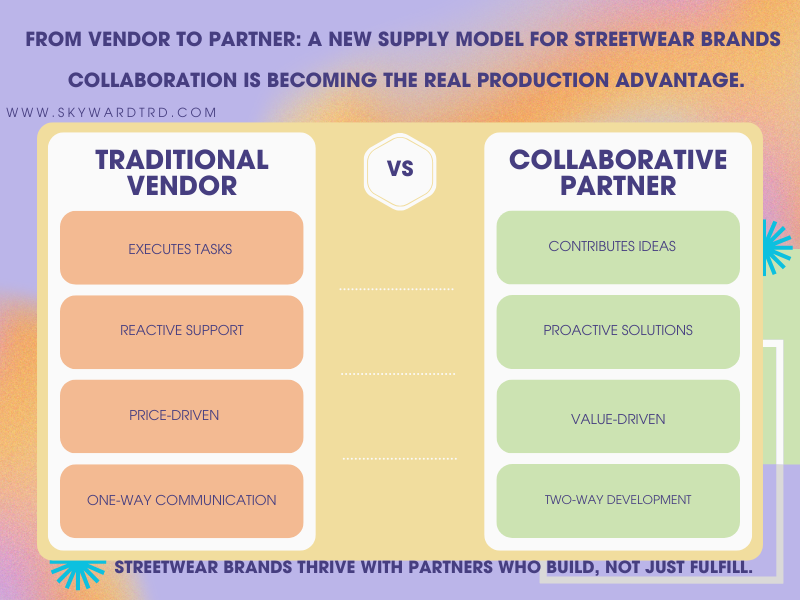
Here’s a quick comparison between traditional vendors and collaborative supply partners:
Speed and flexibility are now just as crucial as design
Streetwear has always been defined by pace and personality. Brands operate on tighter timelines, faster drops, and high-visibility creative cycles. But bringing bold ideas to market quickly takes more than just inspiration, it requires a supply partner who can keep up with that rhythm.
Many brands discover this when moving from simple items like tees and hoodies into more technical categories like outerwear, pants, or mixed-fabric pieces. Suddenly, the margin for error shrinks, and timelines tighten. Delays in sampling, confusion in communication, or material sourcing setbacks can compromise an entire release.
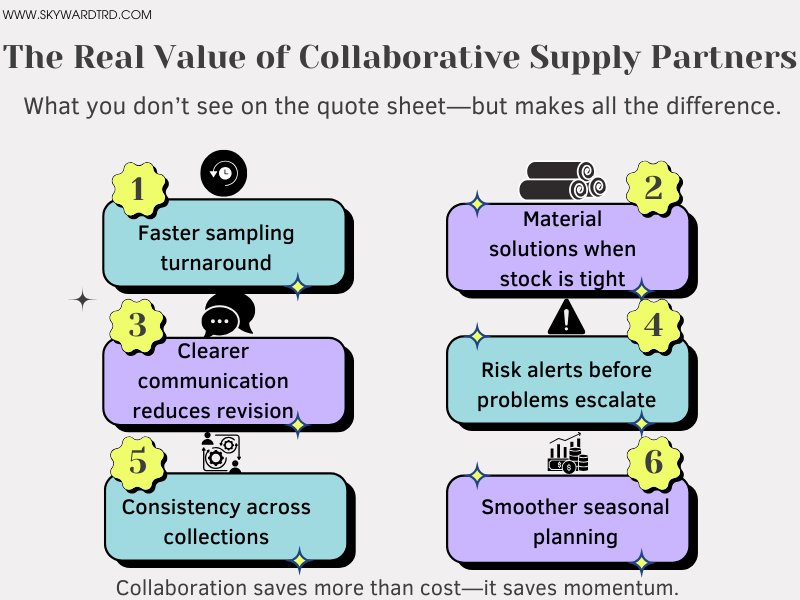
What collaborative suppliers bring to the table is more than just production, they bring proactive problem-solving. They flag risks before they become issues, offer material alternatives when needed, and work with you to ensure your timeline is met without compromising your design integrity.
And while these contributions may not appear on a quote sheet, they are often what determine whether a project succeeds or stalls.
Here’s what you gain from a collaborative supplier, beyond what’s written on a quote sheet:
Collaboration is not an extra, it’s the new standard
This shift toward collaborative supplier relationships is not unique to streetwear. Leading industry research, from McKinsey to Business of Fashion, has highlighted a global movement toward strategic partnerships in sourcing.
More and more brands are moving away from purely transactional vendor models and investing in supply chains built on shared responsibility and long-term alignment.
But for streetwear brands, this shift is even more relevant. With products that rely heavily on detail, material nuance, and stylistic cohesion, success depends on more than just manufacturing capacity.
It depends on whether your supplier understands your brand language, your customer expectations, and your development rhythm.
That kind of alignment doesn’t happen in one email exchange, it’s the result of an ongoing working relationship that builds over time.
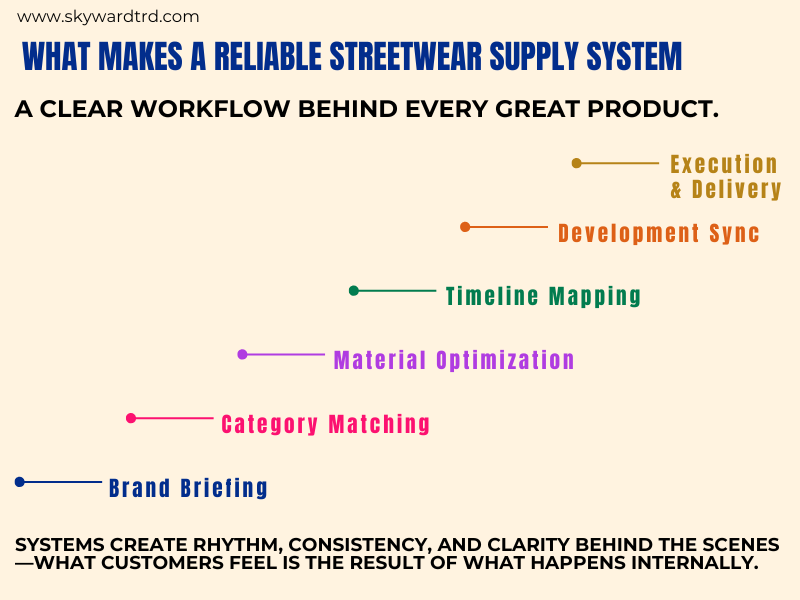
A reliable supplier partnership is built through a structured, collaborative workflow like this:
And when that relationship is strong, the benefits ripple across your entire business, from fewer revisions to smoother category launches and more confident product planning.
Cost is important, but compatibility drives long-term value
Of course, cost still matters. Every brand has budgets to manage. But many teams find that the “cheapest” supplier often comes with hidden costs, more rework, longer back-and-forth, delayed shipments, or inconsistent quality.
In contrast, a slightly higher-cost supplier who brings consistency, clear communication, and solution-oriented support may ultimately save you time, protect your margins, and strengthen your overall brand performance.
As one of our longtime streetwear clients once said, “We realized we weren’t just buying production, we were buying peace of mind.”
Explore What Really Powers Streetwear Brand Growth
And that kind of value, while not always visible on a spreadsheet, is what makes growth sustainable.
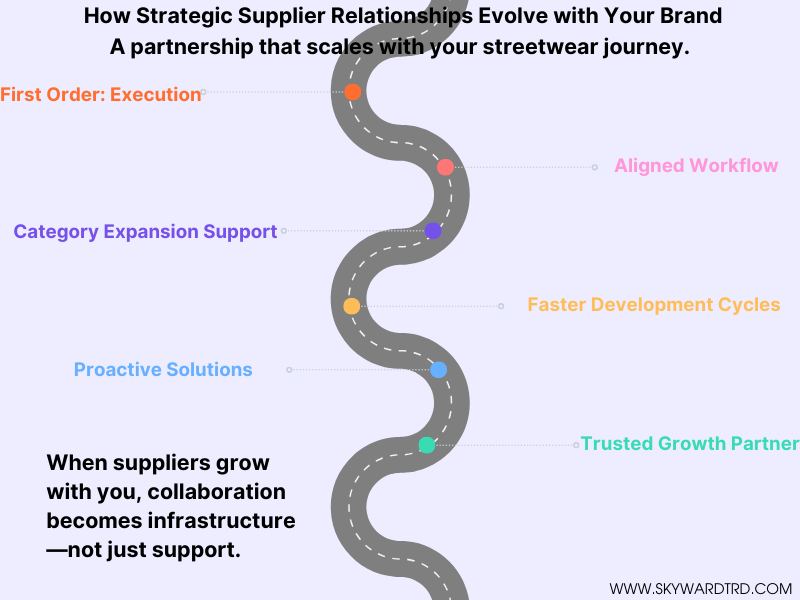
The most strategic partners are the ones who grow with you
Having worked with streetwear brands across different stages, from small capsule startups to expanding global players, we’ve seen firsthand what makes supplier relationships last.
It’s not just pricing. It’s not just capability.
It’s the ability to evolve with the brand, adapt to new needs, and build mutual understanding that turns one successful drop into a long-term collaboration.
In a creative industry where everything moves fast, it’s tempting to treat sourcing as a series of transactions. But the most resilient brands treat it as infrastructure, a part of their business model, not just their to-do list.
How Streetwear Brands Stay Relevant Beyond Trends
Why collaborative partners are the foundation for scalable, sustainable brand growth:
So if your team is currently exploring new directions, refining your cost structure, or expanding product categories, it may be time to ask:
Are we simply choosing suppliers based on price?
Or are we seeking partners who can support our long-term rhythm and growth?
We’re here to help streetwear brands build not only better products, but better systems behind them. If you’re looking for a supply partner who does more than quote, we’d love to be part of your next chapter.
Working with a trusted custom streetwear manufacturer ensures that your brand’s designs and quality are consistently delivered as it grows.
If your brand needs a supplier that can support clearer development and production decisions, contact SKYWARD to discuss your next collection.