
Streetwear sampling insights matter because many product problems appear before bulk production begins. When materials, fit comments, trims, construction details, and supplier communication are unclear, a sample can look promising but still fail later.
Streetwear sampling is where design gets tested and products either work or fail. design starts the process, but sampling reveals what actually works.
For many streetwear brands, the most exciting part of product development is watching an idea turn into a real garment. After rounds of sketches, fabric sourcing, and reference discussions, the first sample finally arrives.
At that moment, everything feels closer to completion.
But in reality, this is often where the product quietly begins to fall apart.
What looked balanced on paper can feel different on the body. Materials that seemed perfect in theory may behave unpredictably. Construction details that felt minor during design suddenly start to matter.
Sampling does not just move a product forward. It exposes everything that design alone cannot resolve. This is where the streetwear sampling stage begins to reveal whether a product can truly work in real manufacturing.
For manufacturers working with streetwear brands, this stage is not about confirming the design. It is about understanding whether the product can actually perform consistently in the real world.
Explore our streetwear product development process
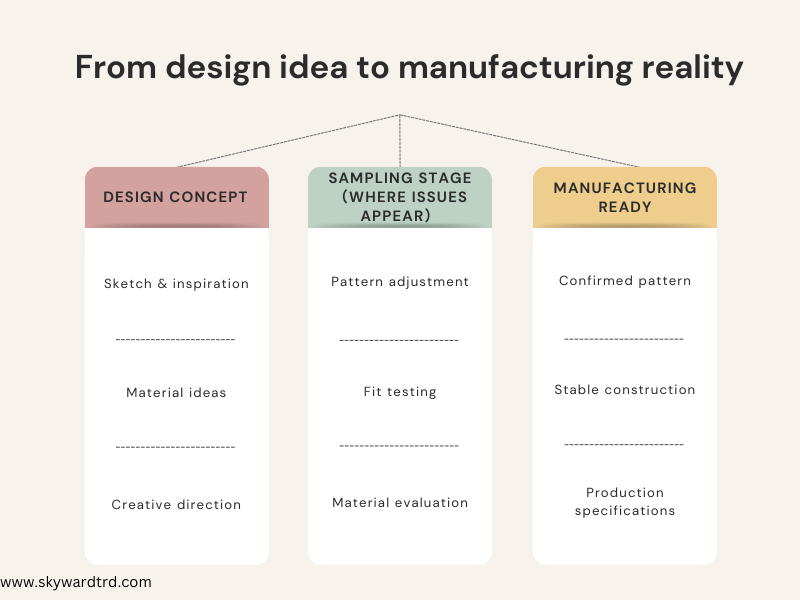
When creative ideas are tested against real materials and construction
A design can feel complete long before it is physically made.
Proportions look intentional, details feel resolved, and the concept appears clear. But once the garment is constructed, a different layer of reality emerges.
Fabric weight begins to influence shape and movement. Panel structures affect how the garment sits on the body. Functional details start to interact with wearability.
This is usually where the first signs of failure begin to show.
Not as obvious mistakes, but as subtle inconsistencies.Something feels slightly off. The balance is not quite right. The garment works visually, but not physically.
These moments are easy to overlook, especially for brands focused heavily on aesthetics. But in manufacturing, these small misalignments tend to grow.
Sampling is where these issues surface early, before they become difficult to control. This is why sampling decisions in streetwear development directly impact manufacturing outcomes.
For experienced streetwear brands and manufacturers, this stage becomes a process of observation and adjustment. Each revision moves the product closer to something that not only looks right, but performs consistently.
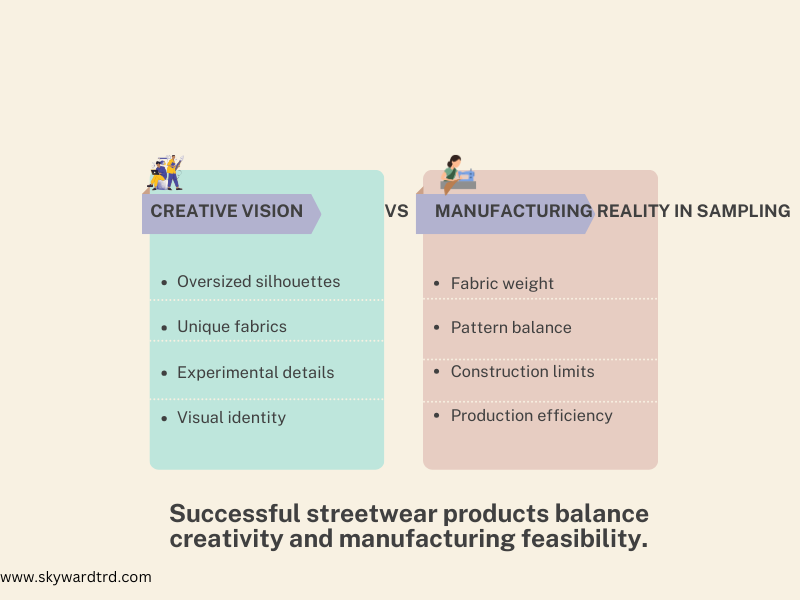
Good design attracts attention, but sampling determines whether a product holds up
In streetwear, design is often what creates the first impression.
A strong silhouette, a bold graphic, or an unexpected material choice can immediately capture attention. This is what draws people in.
But what keeps a product relevant goes beyond appearance.
Once a garment is worn, different questions begin to matter. Does it feel comfortable? Does it maintain its structure? Does it hold up after repeated use?
These questions cannot be answered in design. They are answered in sampling, especially within a well-managed streetwear sampling stage.
This is also where many products quietly fail.
Not because the idea was weak, but because the execution could not support it.
A slight imbalance in pattern structure can affect fit across sizes. A seam placed without considering stress points can reduce durability. A fabric choice that looks right visually may not perform well over time.
See how we support cut and sew manufacturing for consistent quality
Through sampling, these issues are identified and refined.
Sometimes the changes are minimal. A small shift in proportion, a reinforcement detail, or an adjustment in material composition.
Individually, they seem minor. Together, they define the difference between a product that simply looks good and one that actually works in real manufacturing conditions.
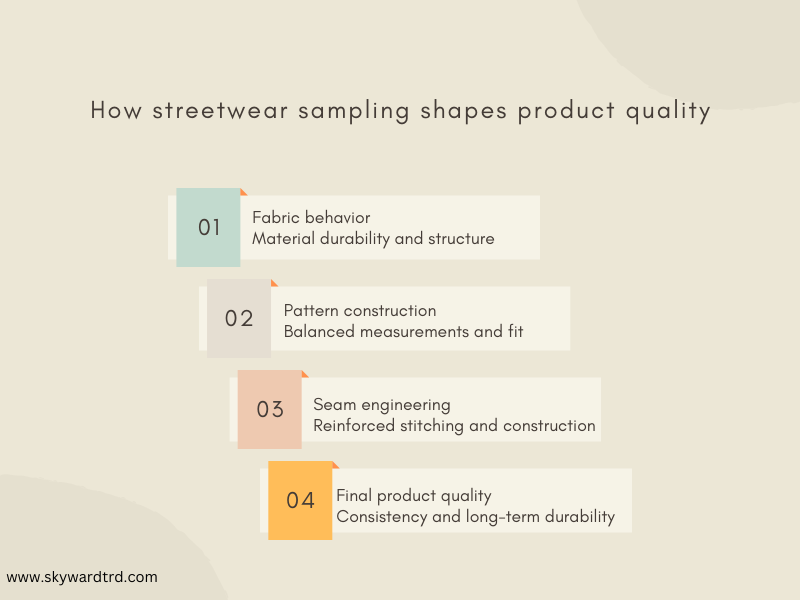
Manufacturing consistency begins with clarity at the streetwear sampling stage
Sampling is not only about improving the garment itself. It also sets the foundation for manufacturing.
Once a sample is approved, it becomes the reference point for everything that follows. Patterns, measurements, and construction methods are standardized.
For streetwear brands planning to scale production, this clarity is essential.
Without it, inconsistencies begin to appear. Sizing may vary. Construction details may shift. Quality becomes harder to control.
What started as a small issue during sampling can expand significantly during production.
Learn how our manufacturing system ensures production consistency
This is where the connection between streetwear sampling and manufacturing becomes most visible.
A well-developed sample creates alignment. It allows manufacturers to reproduce the garment with consistency and predictability.
For brands, this means fewer surprises and more control over the final product.
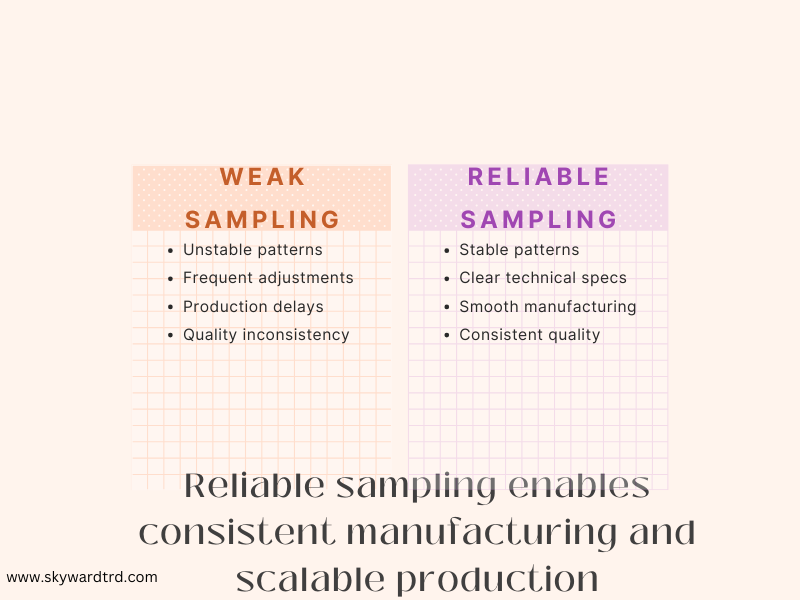
Strong streetwear brands treat sampling as part of a long-term system
Over time, sampling becomes more than a single stage in development.
It becomes part of how a brand learns.
Each sample provides insight. Materials behave differently under different constructions. Patterns evolve. Technical decisions shape long-term outcomes.
Brands that pay attention to this process begin to build internal knowledge. They understand what works, what needs adjustment, and how to improve over time.
Instead of approaching each product as a completely new challenge, they develop a system that connects creativity with manufacturing experience.
For manufacturers, this shift is noticeable.
Products become more refined. Communication becomes clearer. Development cycles become more efficient.
Sampling, in this context, is no longer just a step. It is where products either quietly fail or become ready for consistent, scalable manufacturing. For any streetwear brand, mastering the streetwear sampling stage is what ultimately connects creative vision with reliable production. A strong streetwear sampling process is what allows brands to scale with confidence.
Working with a trusted custom streetwear manufacturer ensures that your samples are developed with quality and consistency in mind.
For a service-side view of this workflow, review our streetwear sample development process.