Why most manufacturers look similar at the beginning but perform differently over time
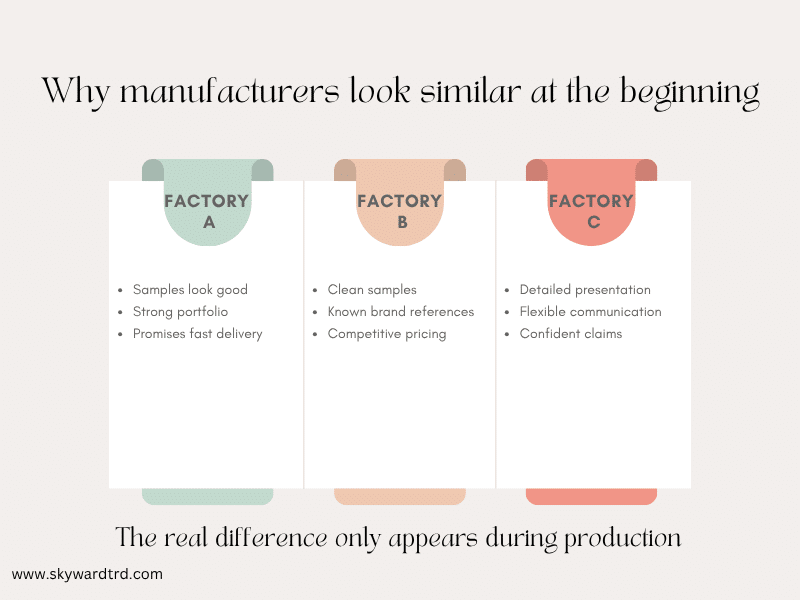
When brands begin garment factory evaluation, the first impression is often reassuring. Different factories present similar capabilities, similar product categories, and similar confidence in what they can deliver.
From the outside, the differences are not obvious.
A clothing manufacturer may show a range of samples, present past work, and communicate clearly about what can be produced. At this stage, it feels like most options are comparable. The decision appears to be about choosing between similar levels of capability during garment factory evaluation.
However, this similarity is often only surface deep.
As collaboration progresses, differences begin to emerge. Some manufacturers maintain consistency across multiple orders, while others struggle as complexity increases. Some handle adjustments smoothly, while others become slower and less predictable.
The question is not why this happens later.
The real question is why these differences were not visible at the beginning of garment factory evaluation.
Why what you see from a manufacturer is designed to look consistent but reveals very little
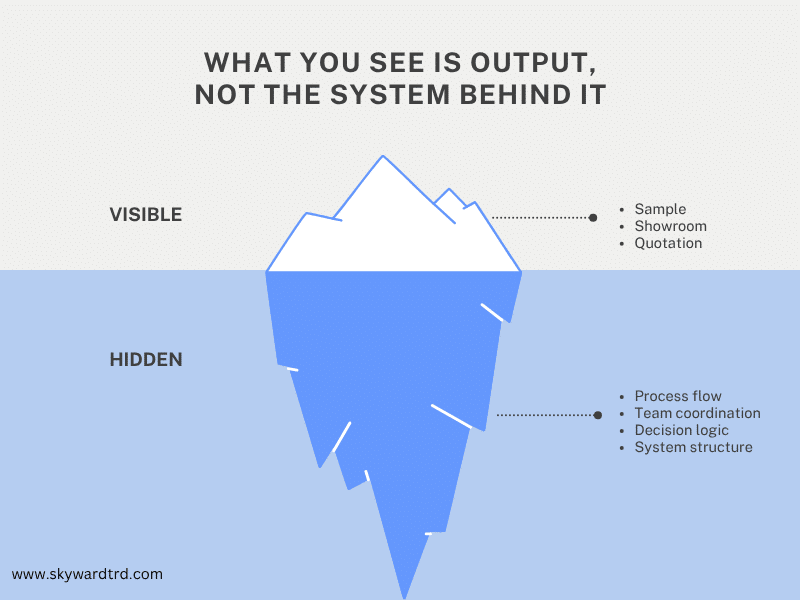
In early evaluation, brands rely on what is visible. Samples are reviewed to assess quality. Showrooms or portfolios are used to understand style and capability. Quotations provide a sense of cost and feasibility.
These elements create a picture of what a clothing manufacturer can do.
But this picture is incomplete.
A sample reflects a single controlled result. A showroom reflects selected outcomes. A quotation reflects an estimate under specific assumptions. None of these elements reveal how the manufacturer performs across multiple stages, timelines, and changing requirements.
Because of this, many manufacturers appear similar when judged by these surface indicators.
What brands see is not incorrect, but it is limited. It represents output, not the system that produces that output.
And it is the system that determines whether results can be repeated, which is the core of effective garment factory evaluation.
The real difference is not in what a manufacturer shows, but how it actually operates
The true capability of a clothing manufacturer is defined by what happens internally.
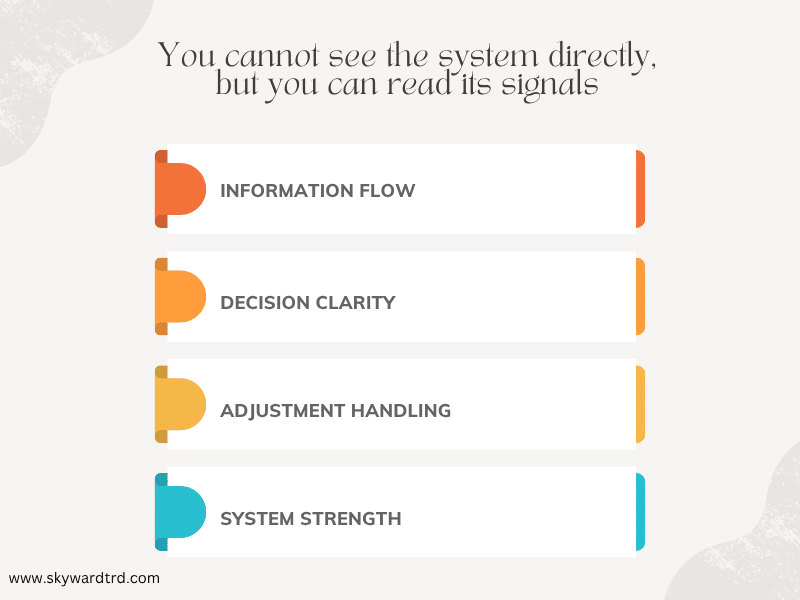
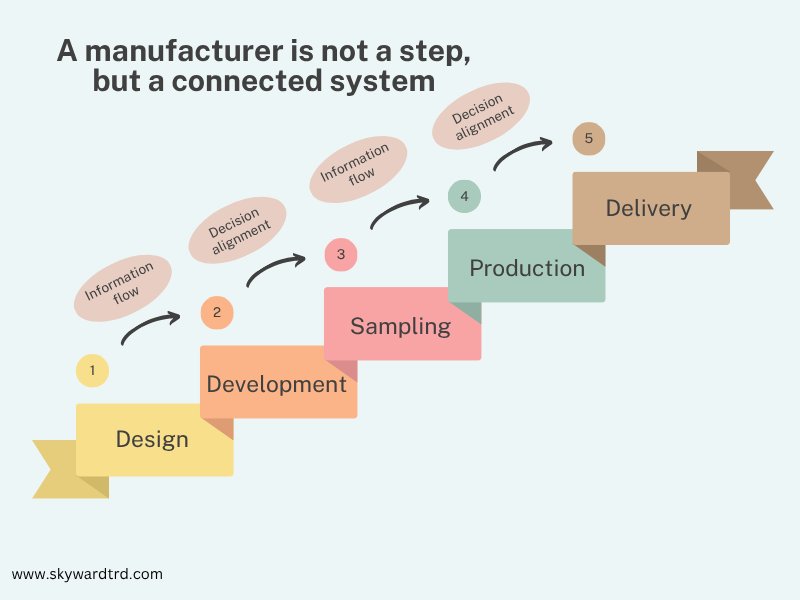
This includes how information moves between teams, how decisions are made during development, and how different stages of work connect to each other. It also includes how adjustments are handled when conditions change.
These are not visible in a sample or a presentation.
They become apparent through patterns.
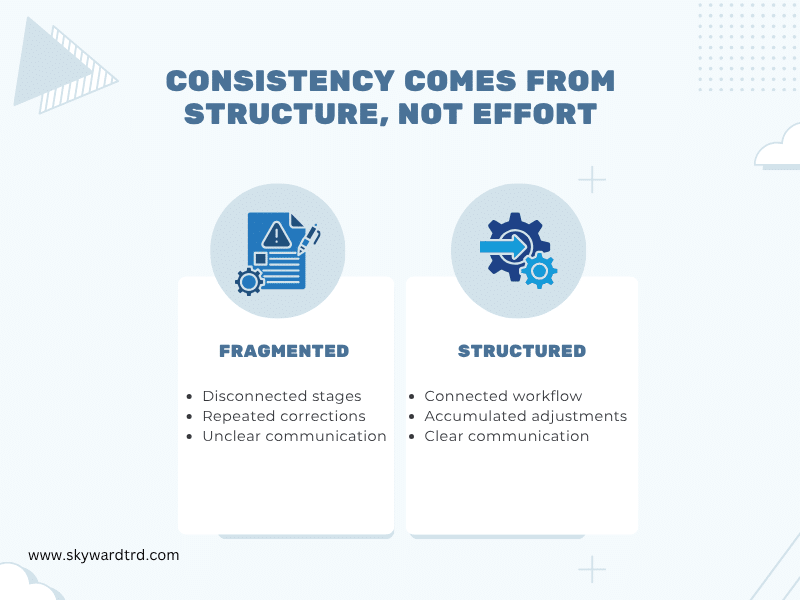
In a well structured manufacturer, information flows with clarity. Development, sampling, and production are connected rather than fragmented. Adjustments are processed without creating confusion, and results can be reproduced with a high level of consistency.
In a less structured environment, the opposite patterns appear. Information becomes inconsistent as it moves between stages. Small changes require repeated clarification. Outputs vary even when inputs remain the same.
These differences are not caused by individual errors. They are reflections of how the system is organized.
Understanding this shifts the focus from what a clothing manufacturer can show, to how it actually operates within a proper garment factory evaluation process.
What actually determines whether a manufacturer can support you long term
When a clothing manufacturer operates with a strong internal system, the collaboration begins to feel different over time.
There is a sense of continuity between stages. What is established during development carries through into sampling and production. Adjustments do not reset the process, but build on what has already been done.
Communication becomes more precise. Instead of simply responding, the manufacturer anticipates what information is needed. Fewer clarifications are required because the structure supports understanding.
Results become more predictable. Not because nothing changes, but because changes are managed within a stable framework.
This does not mean the process becomes simpler. It means the complexity is controlled.
From the outside, this may not be immediately visible. But over time, it becomes one of the most defining characteristics of a reliable clothing manufacturer.
Why learning to read internal systems early will change how you choose a manufacturer
If internal systems are not directly visible, the challenge is learning how to recognize them early within garment factory evaluation.
This requires a shift in what is being observed.
Instead of focusing only on outputs, attention moves to patterns in how work is handled. How clearly information is communicated, how consistently responses align with previous discussions, and how smoothly adjustments are processed.
Early interactions often reveal how a clothing manufacturer organizes its work. Even small exchanges can indicate whether there is alignment between teams, whether processes are structured, and whether the system supports consistency.
The goal is not to find perfection in the beginning.
The goal is to recognize whether the underlying system is capable of supporting stable outcomes over time, which is the ultimate goal of garment factory evaluation.
Because what happens behind the factory door is what ultimately determines everything that follows.